SequenceSequenceHelp Center

How to get started and set up Alpha Pro

Create your Sequence account, connect your exchange with a trade-only API key, and the Sequence team takes it from there. The entire setup usually takes 10-15 minutes.

What you'll accomplish

By the end of this guide, you'll have:

  • A Sequence account ready to use.
  • Your exchange securely connected via a trade-only API key.

Once your exchange is connected, the Sequence team activates Alpha Pro on your account — you don't need to launch anything yourself.

Before you begin

Before starting, make sure you have:

  • Your Alpha Pro invitation code.
  • An account with one of our supported exchanges.

Don't have a subaccount yet? Follow Create your trading subaccount first to create, configure, and fund it before continuing.

Once configured, make sure your dedicated subaccount is funded with at least:

  • Alpha 1x: $30,000 USDT or USDC
  • Alpha 2x: 0.4 BTC or $30,000 USDT or USDC

Recommended: complete the setup on a desktop browser (preferably Chrome). While some steps may work on mobile browsers, creating API keys is significantly easier on desktop and is not supported in most native exchange apps (such as Bybit or Binance).

Note: see the green chat bubble in the bottom-right corner of the app? That's our chatbot — it can assist you at any moment if you have questions during setup.

Setup overview

Setting up Alpha Pro consists of two simple steps:

  1. Create your Sequence account (or sign in).
  2. Connect your exchange via API.

That's it — once your exchange is connected, our team activates Alpha Pro for you, and it begins trading automatically whenever market conditions match the strategy's entry criteria.

Step 1 — Create your Sequence account

Note: the email you register with becomes the primary email of your Sequence account — 2FA codes, invoices, account verification, and private support responses will only be sent there. And if that email is Hotmail, Outlook, Live, MSN, or another Microsoft-hosted address, some platform features may not work correctly: contact support@tradewithsequence.com before continuing so we can help you choose the best setup.
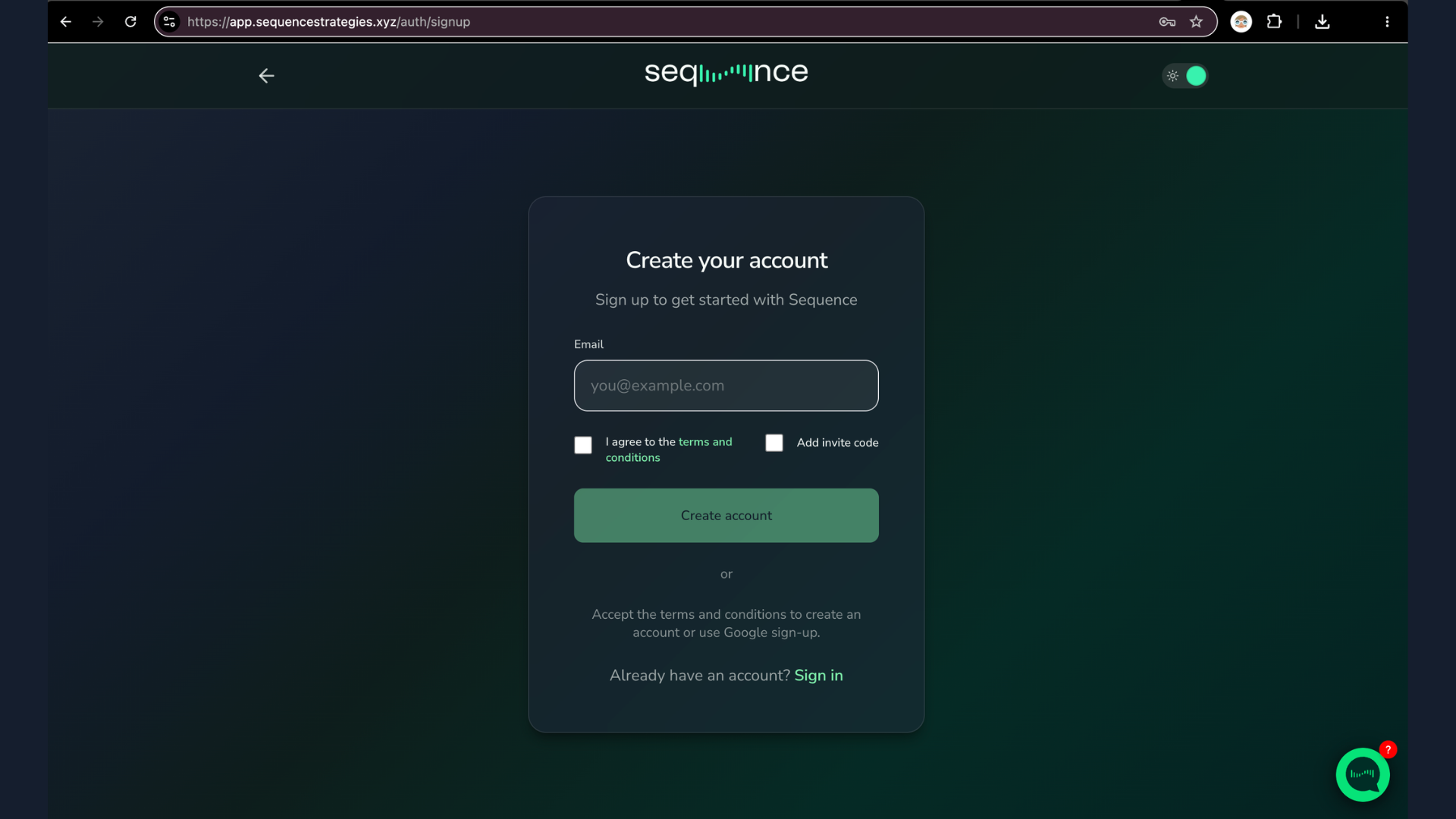
The Sequence signup page — Create your account

Enter your email, accept the terms and conditions, and check Add invite code — Sequence is invitation only. Then complete the form with your name and password, and click Create account (or use Google sign-up).
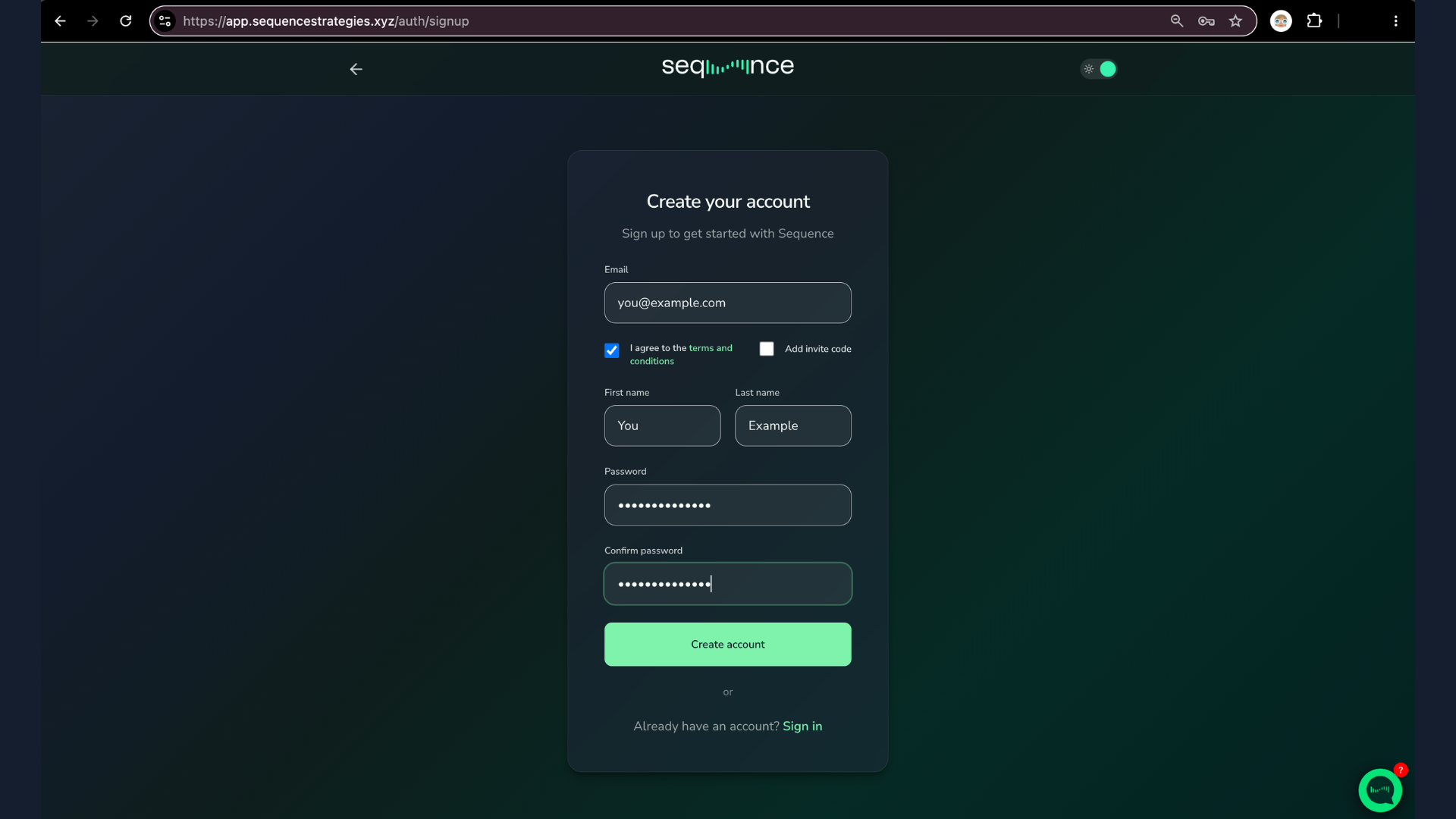
The signup form — email, invite code, name and password

Already have an account? Sign in at app.sequencestrategies.xyz/auth/login.
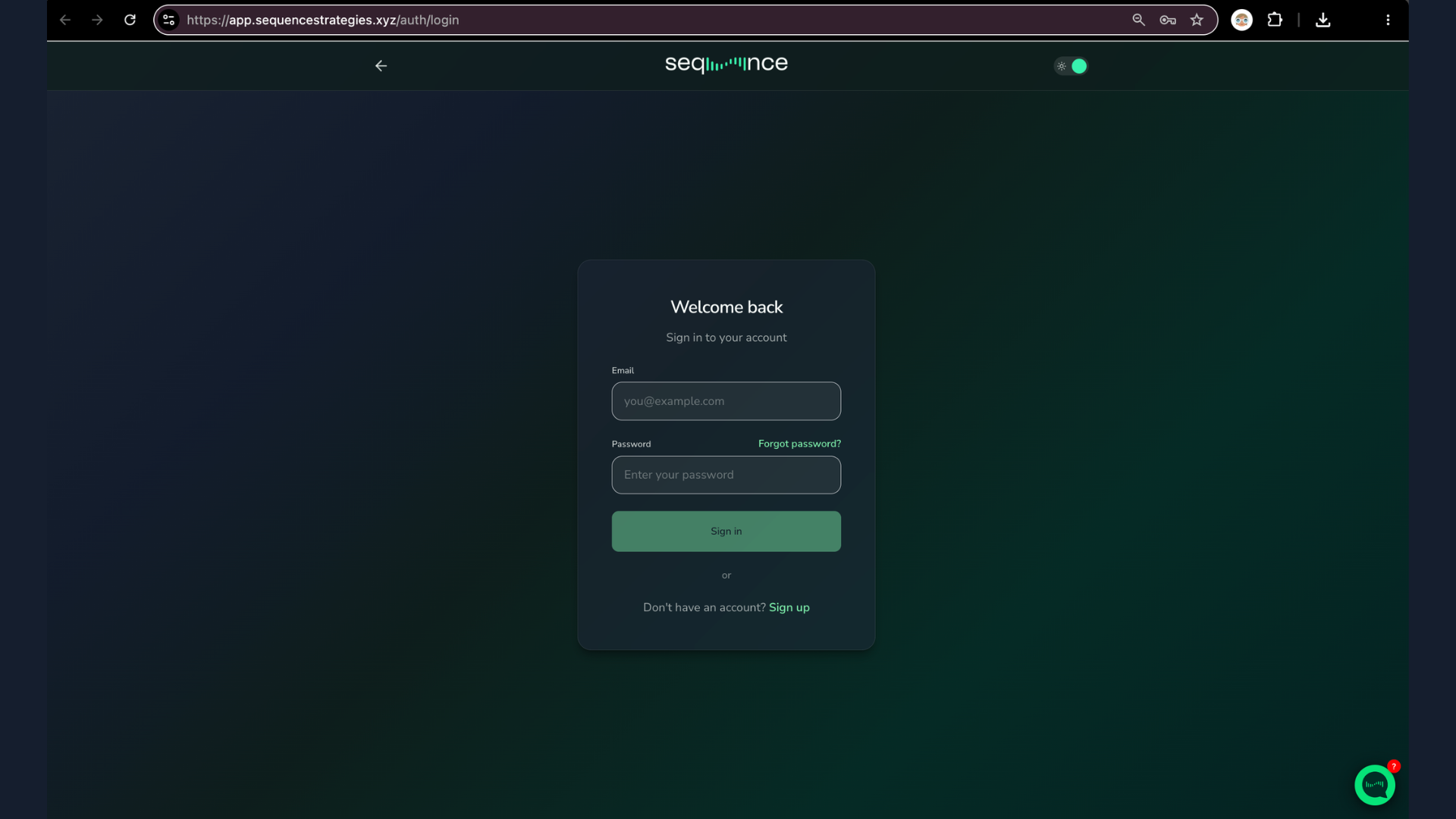
The login page — Welcome back

Step 2 — Connect your exchange

You'll need the API keys from your exchange for this step. Don't have them yet? Follow Create your API keys first — it takes about 5 minutes and shows the exact permissions for your exchange.

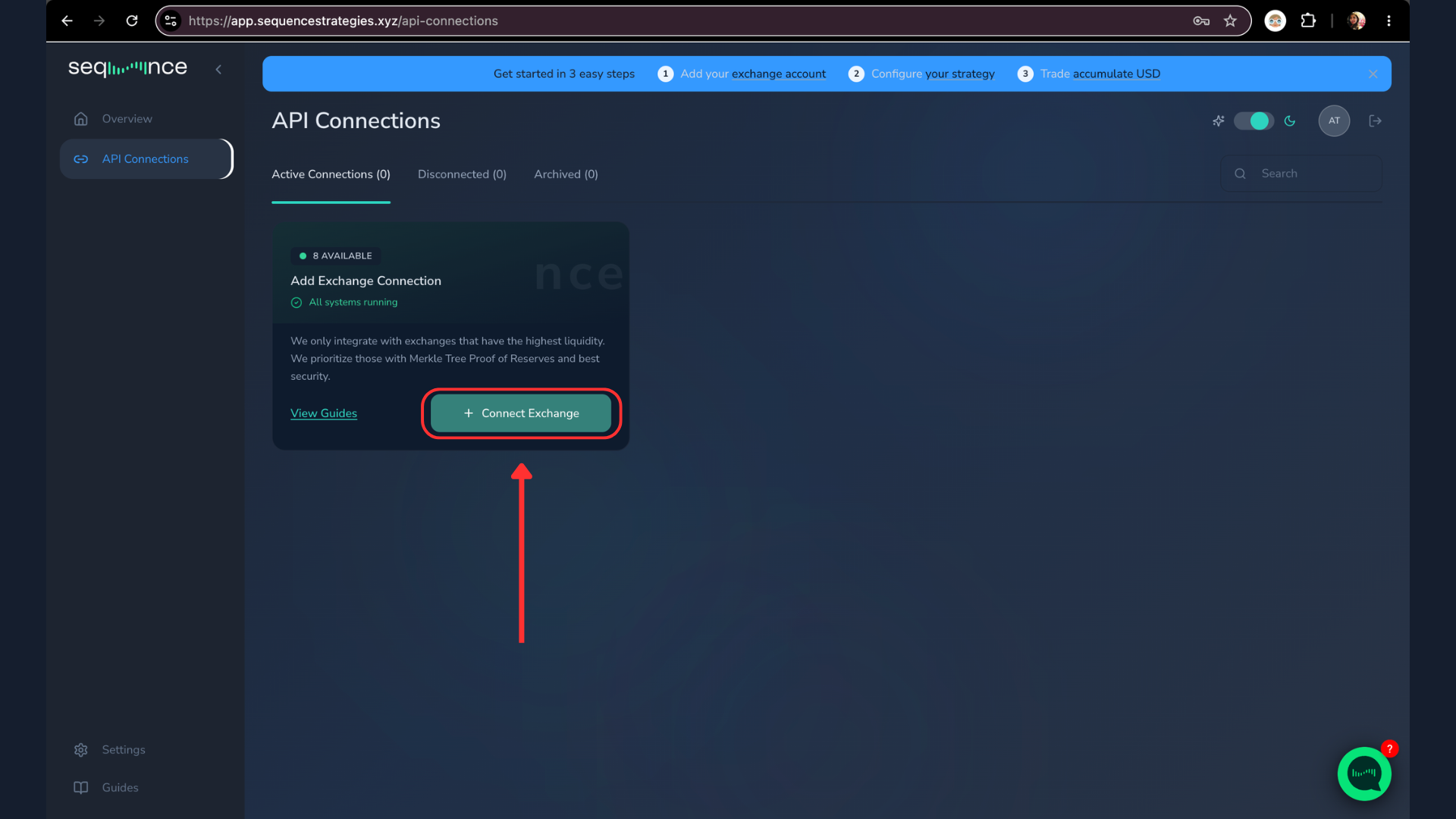
  1. In the left panel, click API Connections.
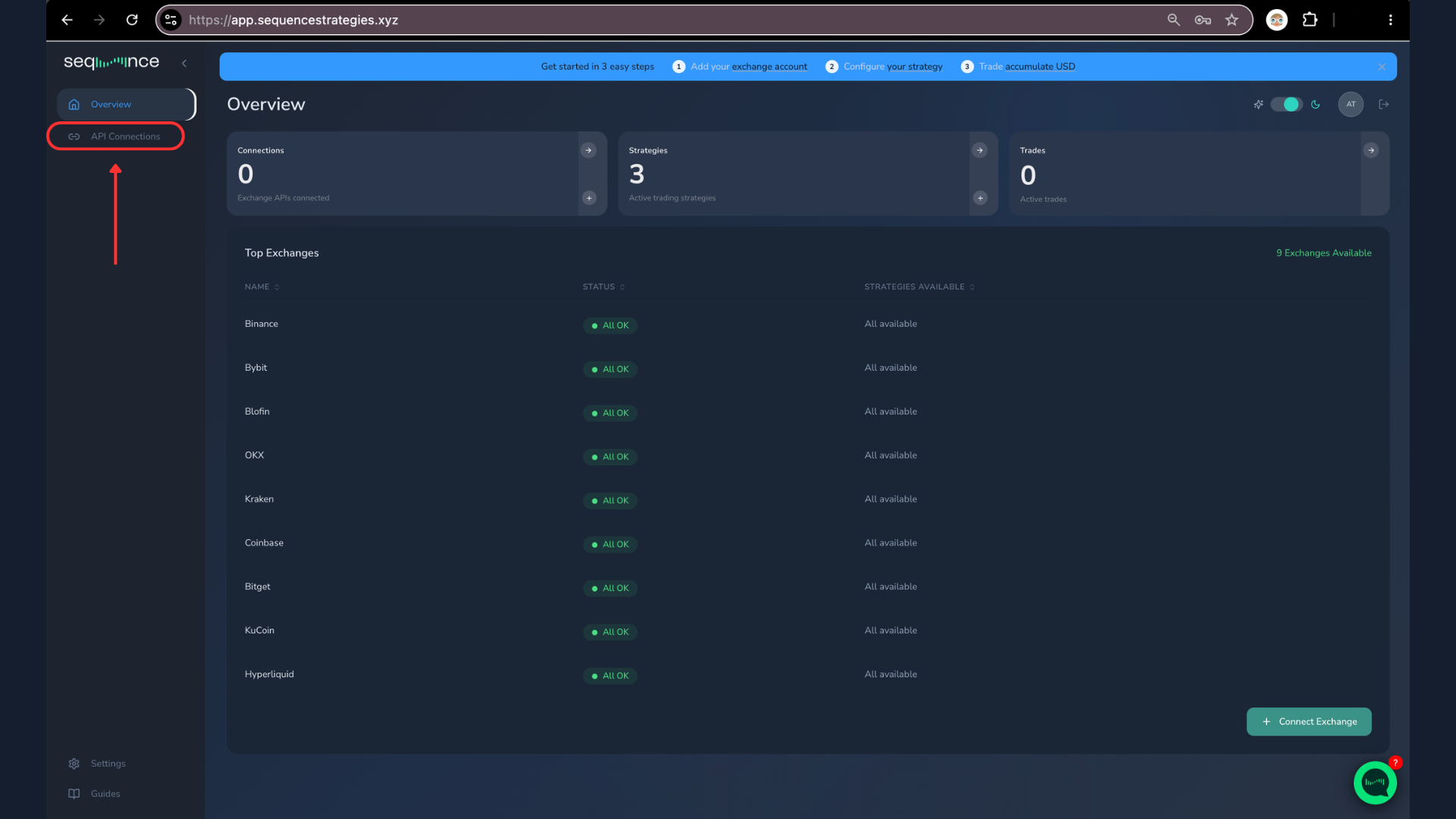
The left panel — API Connections
  1. Click Connect Exchange.
The API Connections page — the Connect Exchange button
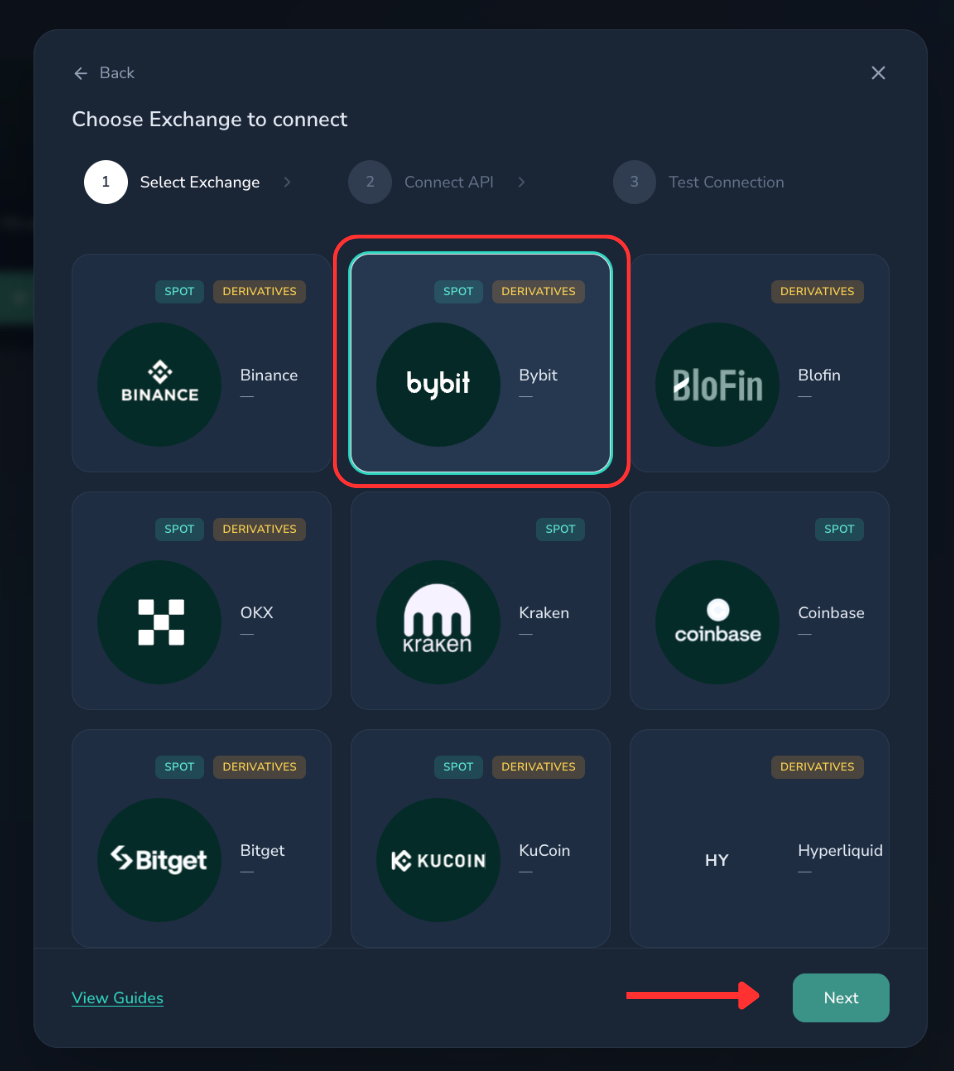
  1. Choose your exchange and click Next.
Choose Exchange to connect, then Next
  1. Complete the form: give the connection a name, paste your API key and API secret (from the key you created on your exchange), and submit.
  1. Our system tests the connection — this takes a few seconds.
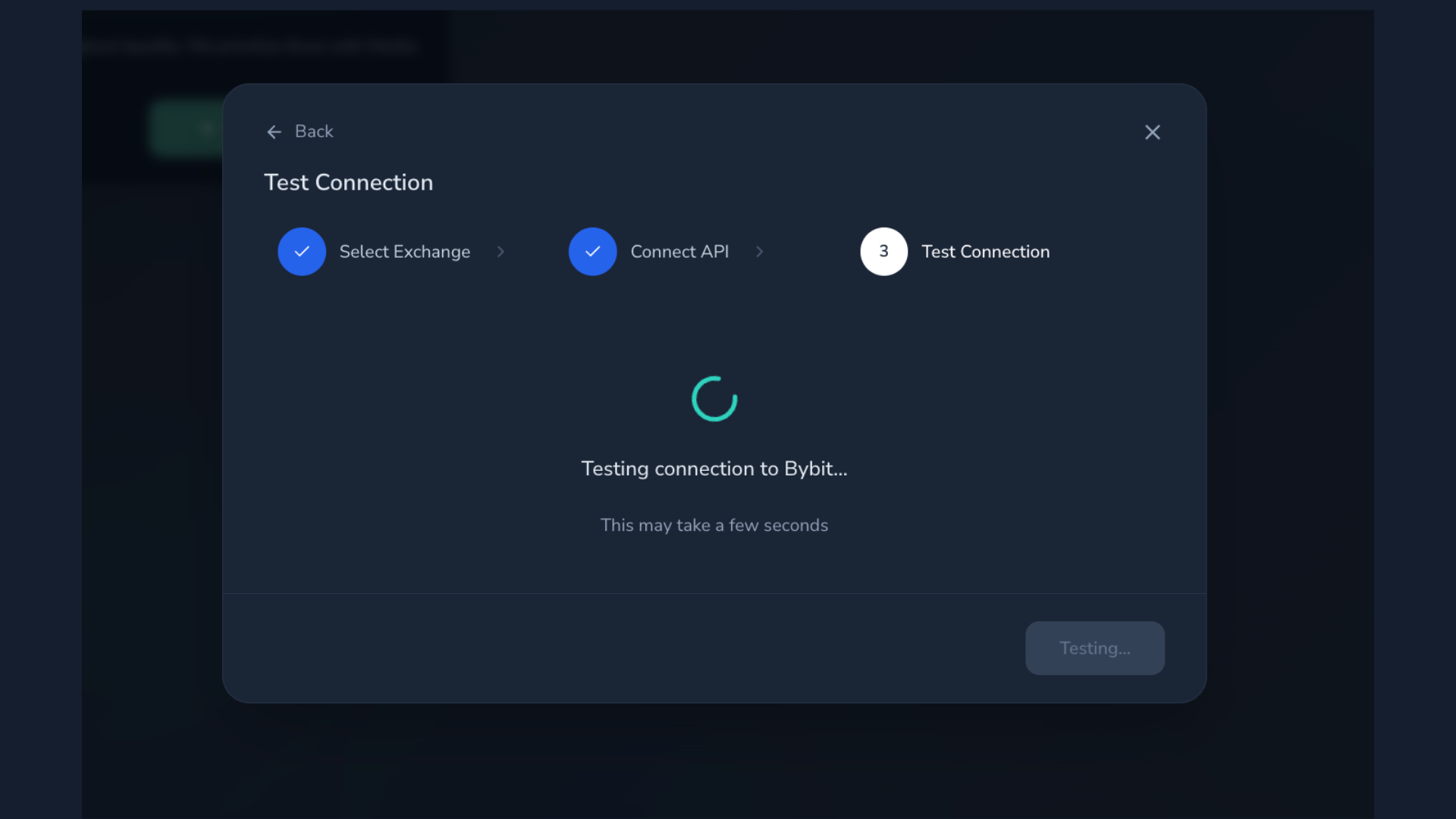
Testing the connection to your exchange
  1. When you see Connection Successful!, click Start Trading.
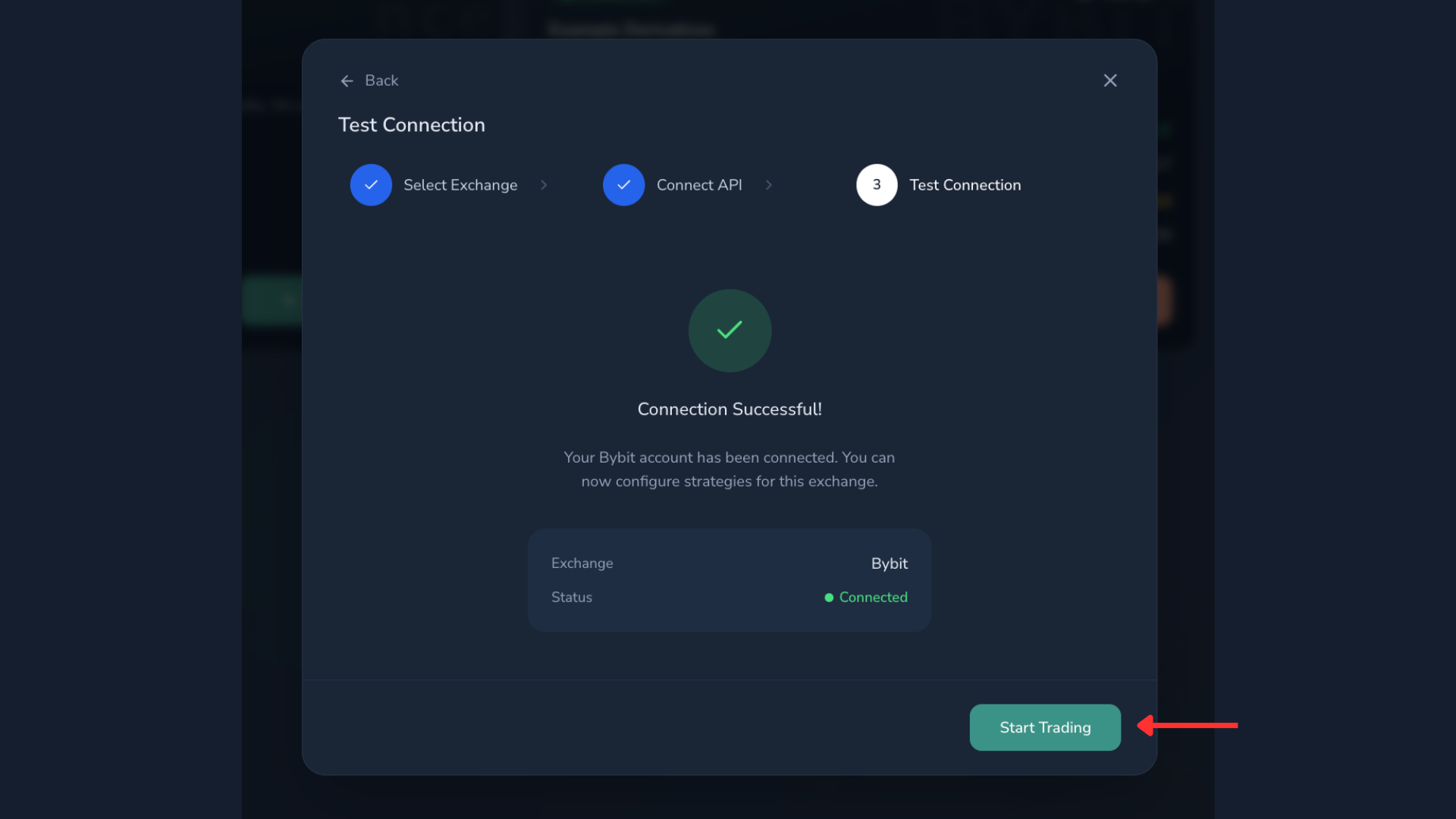
Connection Successful — click Start Trading
  1. Your connection now appears in API Connections, with your available balance.
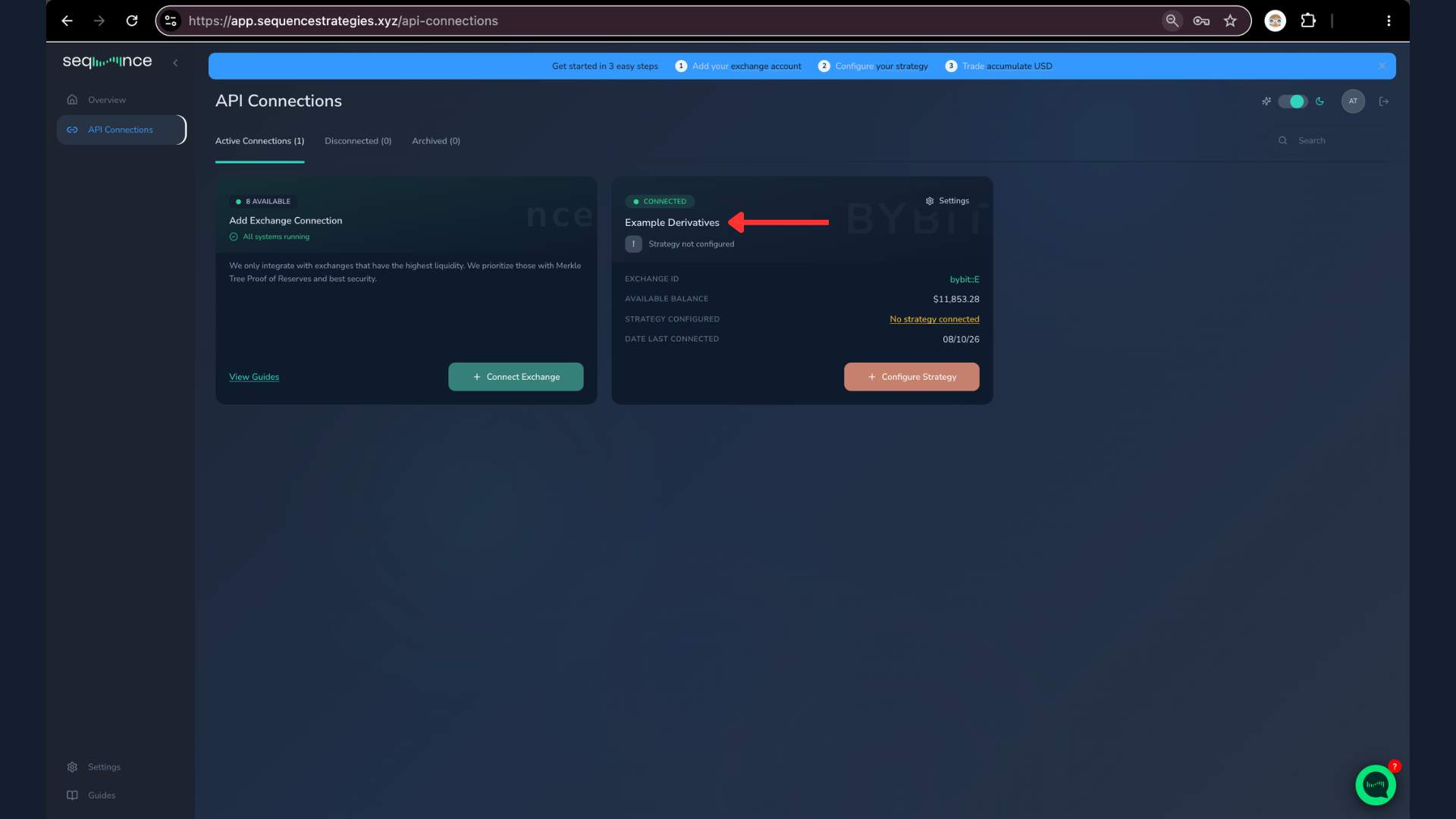
Your new connection listed in API Connections

Troubleshooting: Exchange connection test fails when submitting API keys

If the test ends in Connection Failed (invalid exchange credentials):
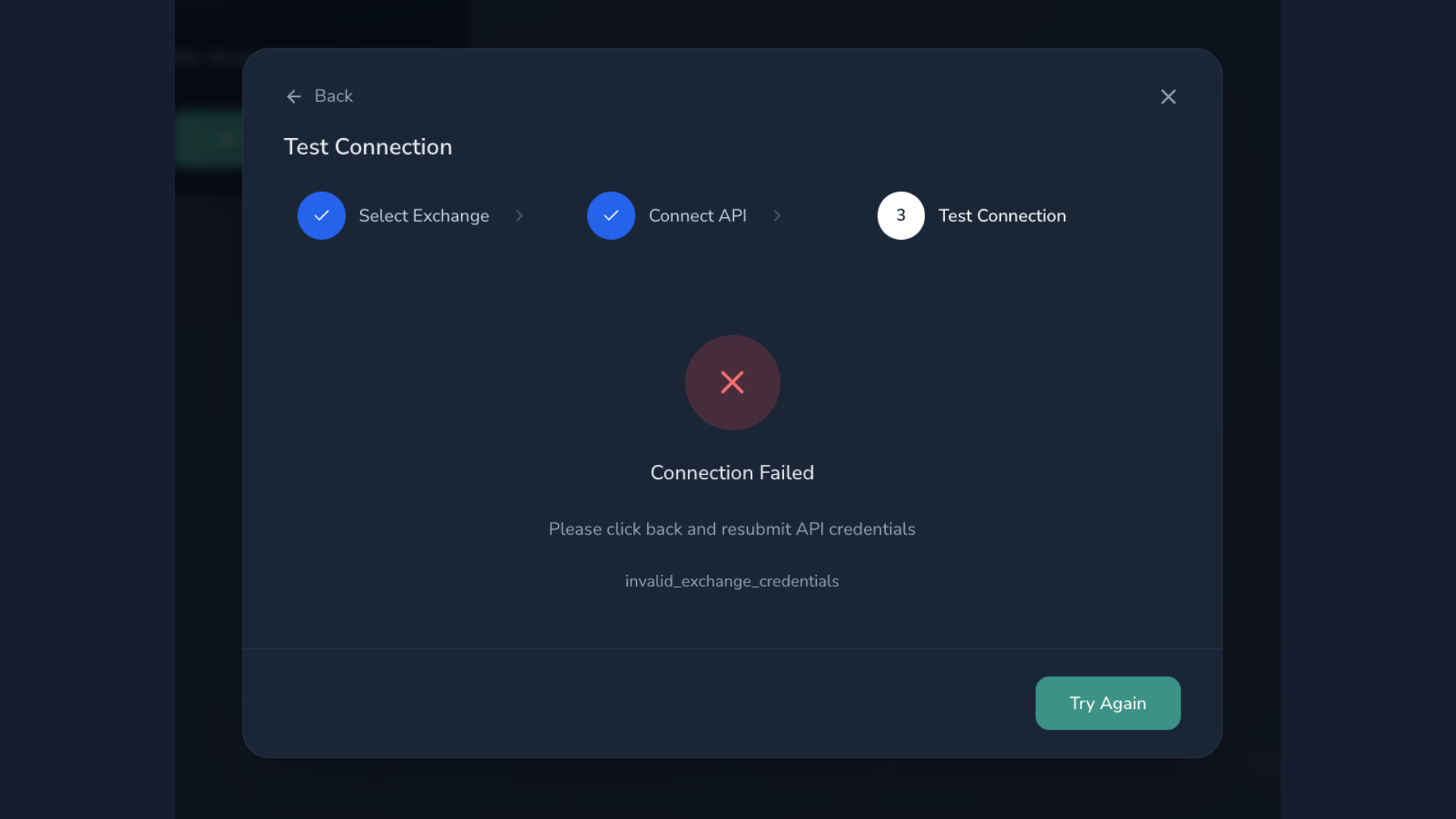
Connection Failed — invalid exchange credentials
  1. Clear your browser's history, cookies and cache — or open a new incognito window.
  2. Create a new set of API keys on your exchange (follow your exchange's page in Create your API keys).
  3. Click Try Again and resubmit the new credentials.

What's next

Once your connection shows as Connected, you're done — the Sequence team activates Alpha Pro on your account, and it starts trading automatically whenever market conditions match the strategy's entry criteria. Questions while you wait? The chat bubble in the bottom-right corner is there for you at any moment.
FAQ

Which exchanges support Alpha 1x and Alpha 2x?

It depends on the version. Alpha 1x only needs a normal spot market, so it runs on every supported exchange. Alpha 2x needs leveraged contracts (derivatives), so it runs only on the venues that offer them. Here's the current supported list, grouped by what each can do: • SPOT ONLY — runs Alpha 1x only: Coinbase, Kraken, OKX, KuCoin. • DERIVATIVES ONLY — runs Alpha 2x: BloFin. • SPOT + DERIVATIVES — runs both Alpha 1x and Alpha 2x: Bybit International, Bitget, Binance International. • SPECIAL CASE: Hyperliquid (DEX) — runs both Alpha 1x and Alpha 2x. So a spot-only venue runs Alpha 1x; a venue with derivatives can run Alpha 2x. If leverage and shorting matter to you, pick a derivatives venue up front — and the team can always confirm which version is active on your account.

Before you start

Do I set my own trade sizes, or does Alpha Pro decide?

Alpha Pro decides each trade's size itself — that's by design. What you control is the total capital the strategy works with (you fund the account, and sizing follows your balance — deposits and realized profits scale trades up automatically) and which version you run: spot Alpha 1x (lower risk) or leveraged Alpha 2x (higher risk). You don't set per-trade amounts.

Your money & profits

Why doesn't Alpha Pro use my whole balance?

It's deliberate. The strategy keeps part of your capital in reserve so it can average down through a dip instead of being fully invested at the top. A large idle-looking balance isn't wasted — it's the reserve that lets the strategy keep buying through a drawdown, which is exactly when it matters most. If you want it to trade larger overall, the lever is a bigger account balance, which flows into sizing automatically from each bot's next cycle.

Can I run Alpha 1x and Alpha 2x in the same account (with BTC collateral)?

No — Alpha 1x and Alpha 2x can't share the same subaccount. They are two separate strategy instances (the spot version and the leveraged version), and each runs on its own capital in its own subaccount. So if you want to run both at the same time, you set up one subaccount for Alpha 1x and a separate one for Alpha 2x — never both together in one. Running both is completely fine; they just live side by side in separate subaccounts. This also keeps their money, their risk, and Alpha 2x's collateral cleanly apart. The team sets this layout up with you at onboarding.

For whitelisting, do I include all seven coins?

Yes — whitelist all seven: DOGE, XRP, ADA, SOL, LINK, ETH, AVAX. The strategy needs to be able to trade any of the seven when conditions are right, so don't whitelist only some of them (or restrict your API key to a few pairs). If you block some coins, the strategy's orders on them get rejected, and repeated failures will trip its automatic safety stop. If you truly want fewer coins, raise it with the team instead of restricting the setup yourself.

If I connect a spot-only exchange, does Alpha 2x fall back to Alpha 1x?

Yes — it adapts automatically. Alpha 2x needs leveraged contracts, so if you connect a spot-only exchange, the strategy simply runs its long-only spot version instead (that's Alpha 1x): same engine, no leverage, no shorting, and no liquidation risk. It won't refuse to trade — your capital keeps working in the spot setup. Just set your expectations to the 1x profile, not the leveraged one. If you specifically want leverage and shorting, connect a derivatives venue and pick Alpha 2x up front.

The collateral switch: which coins count as collateral?

On exchanges that let you post crypto as collateral (like Bybit), each non-stablecoin coin has a switch that decides whether it counts as backing. The rule: coins you're holding as collateral (like your BTC) should be switched ON; coins the strategy actively trades should be OFF. Why: if a coin the bot trades were also counted as collateral, a normal profitable sale of it would suddenly drop the margin behind your other positions. Stablecoins always count, with no switch. The team sets this up with you at activation.

Which exchange is best for running Alpha Pro?

There's no single "best" for everyone, but the default recommendation is Bybit International— it's the most capable and most proven venue: it runs both versions, lets you hold your crypto as collateral, and its unified account is the most efficient setup for how the strategy pools capital. When to pick something else: if you need a US-regulated venue, Coinbase or Kraken (spot-only, so Alpha 1x); if you want leverage but not Bybit, another derivatives venue works too like Blofin. And if you already hold funds somewhere supported, staying there is usually easiest. See the full list: • SPOT ONLY — runs Alpha 1x only: Coinbase, Kraken, OKX, KuCoin. • DERIVATIVES ONLY — runs Alpha 2x: BloFin. • SPOT + DERIVATIVES — runs both Alpha 1x and Alpha 2x: Bybit International, Bitget, Binance International. • SPECIAL CASE: Hyperliquid (DEX) — runs both Alpha 1x and Alpha 2x.

Which wallet do my Alpha 2x funds go in (COIN-M vs USDT-M)?

Never the COIN-M (coin-margined) wallet — Alpha 2x only trades USDT/USDC-margined contracts. Where exactly the funds go depends on the exchange. On Bybit there's one unified account: you just deposit there and it backs everything (and if you're posting crypto instead of stablecoin, set the collateral switches with the team). On Binance the wallets are separate — fund the USD-M Futures wallet specifically. A very common first-trade failure is funding the Spot or COIN-M wallet by mistake: the account 'has money' but the bot's wallet is empty and the first order fails. If your trades aren't firing after activation, check the wallet first.

Did this answer your question?

Chat with Leo ?